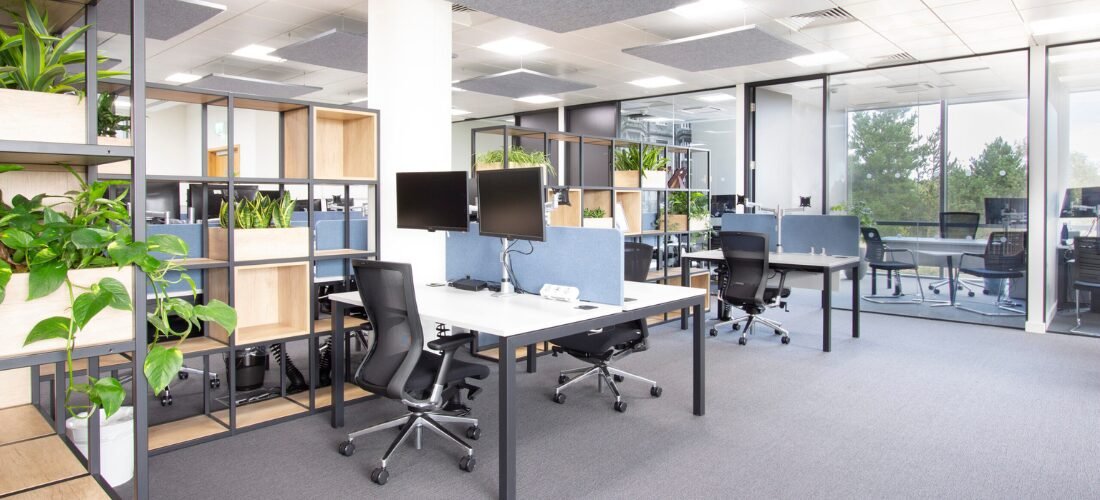
Creating the right working environment has never mattered more. Businesses are investing in office fit-outs to attract talent, lift productivity, and reflect their brand — whether that’s a full-scale refurbishment, a new co-working space, or a smaller project like updated lighting and furnishings. Whatever the scale, the costs involved can be significant, and paying for them upfront isn’t always the smartest way to fund the work.
Office fit-out finance offers a more efficient route: instead of one large payment, the cost of design, furniture and installation is spread over time — allowing a business to create the workspace it actually wants without putting unnecessary pressure on cash reserves.
Why Office Fit-Outs Are Essential
A fit-out is more than new desks and paint — it’s an investment in how a business operates and how its people perform. The reasons companies commit to one are usually some combination of:
- Talent attraction and retention — a modern, well-designed workspace helps businesses recruit and keep good staff
- Productivity gains — better layouts and ergonomic design support how people actually work
- Client impressions — a professional, well-designed office builds trust with customers and visitors
- Hybrid work adaptation — offices increasingly need reconfiguring for flexible working patterns rather than a full week of fixed desks
- Compliance and safety — meeting building regulations, accessibility requirements and energy efficiency standards
The benefits are clear. The costs, once furniture, technology and construction are all added up, tend to be considerable.
Where the Cost Actually Goes
Fit-out projects typically span several categories, and it’s easy to underestimate the total by focusing on just one:
- Design and project management — planning, drawings and oversight of the project
- Construction and partitioning — walls, flooring, ceilings and electrical work
- Furniture and fixtures — desks, chairs, storage and lighting
- Technology and connectivity — IT infrastructure, AV equipment and cabling
- Compliance costs — fire safety, HVAC, accessibility and sustainability upgrades
Paying for all of this upfront is often simply unrealistic for a growing business, which is exactly where finance plays its part.
How Fit-Out Finance Actually Works
Fit-out finance spreads the cost of a project over a fixed period — typically between one and seven years, depending on the scope of the work and the business’s preference. The process itself is straightforward:
- Project agreed — the business confirms design and costs with its supplier or contractor
- Finance arranged — a lender funds the project, paying suppliers directly
- Work completed — the fit-out is delivered as planned, without waiting on cash flow
- Repayments made — the business repays the finance in regular instalments over the agreed term
This structure lets a project move forward on schedule, while keeping the business’s financial position stable throughout.
The Benefits, in Practice
- Preserve working capital — avoid draining reserves on a single large upfront cost
- Immediate project delivery — start the fit-out without waiting to save up or free up cash
- Flexible terms — repayments structured over 1–7 years to suit the project and the business
- Comprehensive coverage — finance available across furniture, IT and construction, not just one category
- Tax efficiency — repayments are generally treated as an allowable business cost
- Supports long-term growth — a workspace built to last, funded in a way that doesn’t compromise day-to-day trading
Case Example: A Law Firm Refurbishment
A law firm in Birmingham wanted to modernise its 5,000 sq ft office with new furniture, partitioning and technology. Paid upfront, the £150,000 project would have significantly reduced the firm’s cash reserves. Instead, by arranging a five-year finance facility, the firm spread the cost into manageable monthly repayments — allowing the fit-out to go ahead without disrupting day-to-day operations.
More Than One Way to Fund a Fit-Out
Fit-out projects don’t have to be funded through a single product. Depending on the shape of the project and the business’s wider financial position, there are four main routes worth considering:
- Asset finance — spreads the cost of furniture, IT equipment and fixtures over the project term
- Invoice finance — unlocks cash already tied up in unpaid invoices to help fund the project
- Business loans — a flexible lump sum to cover refurbishment or expansion costs more broadly
- VAT loans — spreads a quarterly VAT bill over three months, easing pressure around HMRC deadlines that might otherwise land in the middle of a project
For larger or more complex fit-outs, it’s common to combine more than one of these — asset finance for the physical fit-out, for example, alongside a VAT loan to smooth a quarterly bill that happens to fall during the project.
Getting Fit-Out Finance Right
Because so much of a fit-out’s cost has no resale value once installed, the right finance partner matters — one that understands the sector, has a genuinely wide panel of lenders to secure competitive terms, and can structure a facility around the specific project rather than offering a one-size-fits-all product. Fast turnaround matters too: fit-outs are usually tied to a lease start date or relocation deadline, so approvals need to keep pace with the project timeline, not slow it down.
Office fit-outs are strategic investments that directly affect productivity, culture and growth. Fit-out finance simply makes them achievable without putting that growth on hold to save up first.
Tell us what you’re planning and what pressure you’re feeling on cash flow — we’ll map out the quickest route to approval and a sensible monthly cost.
Ready to Make Asset Finance Work for Your Business?
Partner with MacManus Asset Finance Ltd, an independent broker established in 2005, helping UK SMEs access tailored finance solutions. Our friendly, professional, and consultative team works across all industries and can guide you through hire purchase, leasing, and finance lease options. With access to over 60 finance companies and full FCA authorisation, we ensure your business finds the right solution for growth.