



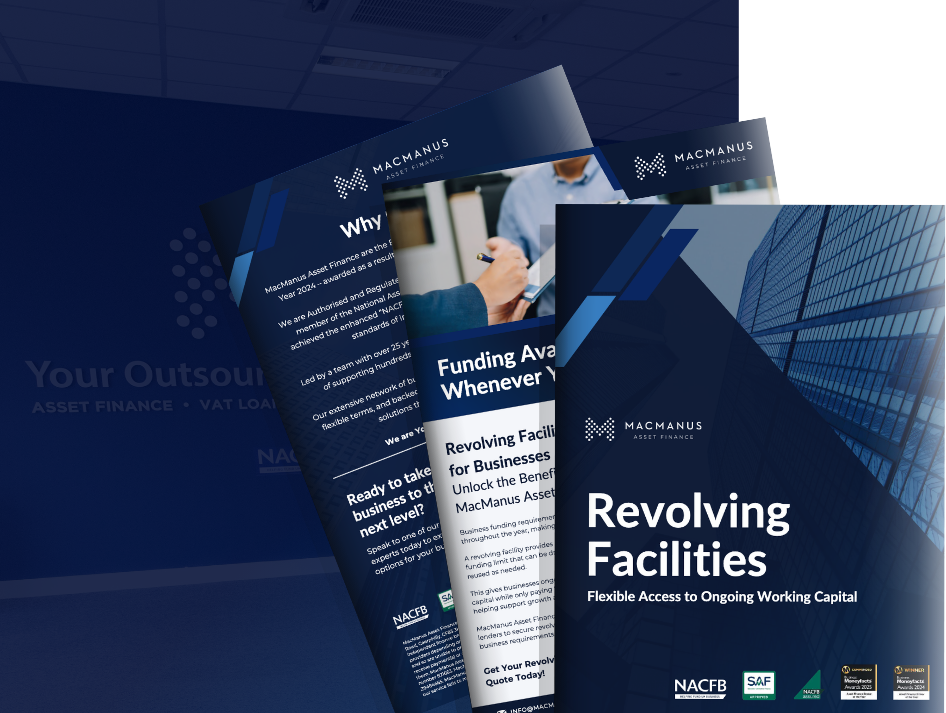




Revolving Credit Facilities for
UK Businesses

Flexible access to working capital when your business needs it most.
Home » Solutions » Revolving Facilities
A revolving credit facility is a type of flexible business finance that allows companies to access funding as needed up to an agreed limit. Unlike a traditional business loan where funds are borrowed as a fixed lump sum, revolving credit facilities allow businesses to draw down, repay, and reuse funds repeatedly throughout the agreement term.
For many UK SMEs, revolving credit facilities provide a practical way to manage:
Because businesses only borrow what they need at a given time, revolving credit facilities can offer greater flexibility than conventional term loans.

Because businesses only borrow what they need at a given time, revolving credit facilities can offer greater flexibility than conventional term loans.

These facilities are widely used across sectors including:
Whether a business needs flexible access to working capital, support during uneven revenue cycles, or funding to manage growth, revolving credit facilities can provide ongoing liquidity without requiring repeated finance applications.
At MacManus Asset Finance, we help businesses across the UK explore revolving credit solutions tailored to operational requirements, trading cycles, and commercial objectives.

What Is a Revolving
Credit Facility?

A revolving credit facility is a flexible borrowing arrangement that allows a business to access funds up to a pre-agreed limit. As funds are repaid, they become available to borrow again.

This differs from a standard business loan, where:

  • The full amount is borrowed upfront
  • and Repaid over a fixed schedule

With revolving credit, businesses can:

  • Draw funds when required
  • Repay balances
  • Reuse available credit throughout the facility term

The structure is often compared to a business overdraft, although revolving credit facilities are usually more structured and may provide:

  • Larger funding limits
  • More flexible terms
  • Broader funding applications
Businesses are typically charged interest only on the amount drawn rather than the full facility limit.

How Revolving Credit Facilities Work

Revolving credit facilities are designed to provide ongoing access to working capital.
Asset finance broker helping UK business

The lender assesses:

  • Trading performance
  • Affordability
  • Turnover
  • Cash flow
  • Borrowing requirements


A credit limit is then agreed.

The business can draw funds as needed up to the approved limit.
This may be done:

  • Online
  • Through a dedicated account
  • Via agreed drawdown procedures

Funds may be used for a broad range of legitimate business purposes including:

  • Payroll
  • Supplier payments
  • Stock purchases
  • Operational costs
  • Short-term cash flow support
The business repays borrowed amounts according to the facility structure. As repayments are made, available borrowing capacity is replenished.
Unlike fixed-term loans, revolving credit can continue to be reused throughout the agreement period provided terms are maintained.

What Can Revolving Credit Facilities Be Used For?

Revolving credit facilities are commonly used for ongoing working capital
management rather than one-off purchases.

Managing Cash Flow

Many businesses experience uneven income cycles.
Revolving credit can help businesses manage:
Delayed customer payments
Seasonal trading changes
Temporary liquidity gaps

Supplier Payments

Businesses may use revolving credit to:

  • Pay suppliers promptly
  • Secure stock
  • Maintain operational continuity

Payroll & Operational Costs

Facilities can help businesses manage:

  • Wages
  • Operational expenses
  • Overheads during periods of uneven cash flow

Seasonal Trading

Retailers, wholesalers, and seasonal businesses often require additional funding during:

  • Peak sales periods
  • Inventory build-up
  • Project mobilisation

Growth & Expansion

Growing businesses may use revolving credit to support:

  • Recruitment
  • Marketing
  • Inventory purchasing
  • Operational scaling

Emergency Liquidity

Some businesses maintain revolving facilities as a financial safety net for:

  • Unexpected costs
  • Delayed receivables
  • Operational disruption

Types of Revolving Credit Facilities

Different revolving structures may be available depending on
business profile and lender appetite.
Unsecured Revolving Credit
Some facilities are provided without specific asset security.

Approval is often based on:

  • Trading history
  • Turnover
  • Profitability
  • Credit profile
Secured Revolving Credit

Lenders may secure the facility against:

  • Property
  • Invoices
  • Stock
  • Other business assets

Secured facilities may support:

  • Larger borrowing limits
  • More flexible terms
Revolving Working Capital Facilities

These facilities are specifically designed around:

  • Ongoing operational liquidity
  • Short-term working capital support
Hybrid Facilities

Some businesses use revolving credit as part of wider funding structures involving:

  • Invoice finance
  • Asset based lending
  • Trade finance

Why Businesses Use Revolving Credit Facilities

Many businesses value revolving credit because of its flexibility compared to traditional borrowing structures.
Businesses can borrow only what they need rather than taking a large lump sum upfront.
Revolving facilities help businesses smooth out short-term cash flow fluctuations.
Once funds are repaid, they become available again without requiring a new application.

Businesses can access additional liquidity during periods of:

  • Expansion
  • Increased demand
  • Operational scaling

Revolving facilities can provide reassurance during:

  • Slower payment cycles
  • Market uncertainty
  • Seasonal trading pressure

Benefits of Revolving Credit Facilities

Borrow Only What You Need

Interest is usually charged only on the amount drawn rather than the full approved limit.

Ongoing Access to Working Capital

Funds remain available throughout the agreement term subject to facility conditions.

Flexible Repayment Structure

Businesses can often repay and redraw funds repeatedly.

Supports Cash Flow Planning

Facilities can help businesses manage short-term financial pressure more effectively.

Faster Access to Funds

Once established, revolving facilities often allow relatively quick access to additional working capital.

Can Complement Existing Funding

Revolving credit can work alongside:

  • Commercial mortgages
  • Asset finance
  • Invoice finance
  • Other lending structures

Revolving Credit Facilities vs Business Loans

Businesses often compare revolving credit with fixed-term business loans.

Revolving Credit Facility

Flexible borrowing

Reusable credit limit

Interest on drawn amount

Ongoing access to funds

Working capital focused

Business Loan

Fixed lump sum

One-time borrowing

Interest on full balance

Fixed repayment structure

Often used for one-off investment

The most suitable option depends on:

  • Business requirements
  • Cash flow profile
  • Funding objectives

Revolving Credit Facilities vs Overdrafts

Revolving credit facilities are sometimes compared with business overdrafts.

Revolving Credit Facility

Structured funding agreement

Often larger borrowing limits

More flexible commercial structuring

May support wider business use

Business Overdraft

Linked directly to bank account

Usually lower limits

Traditional banking product

Primarily short-term liquidity

Some businesses use revolving facilities as an alternative to traditional overdrafts.

Industries That Commonly Use
Revolving Credit Facilities

Things to Consider Before
Using Revolving Credit

While revolving credit can offer flexibility, businesses should understand the structure carefully.

Easy access to funding requires careful cash flow management and borrowing discipline.

Borrowing costs can increase if balances remain high over long periods.

Some facilities are reviewed periodically by lenders based on:

  • Trading performance
  • Financial position
  • Account conduct

Some revolving credit facilities involve security over:

  • Business assets
  • Property
  • Receivables

Certain facilities may involve variable rates that can change over time.

Eligibility for Revolving
Credit Facilities

Eligibility varies between lenders, but common considerations include:

  • Trading history
  • Turnover
  • Profitability
    Cash flow
  • Credit profile

Lenders may also assess:

  • Sector stability
  • Existing borrowing
  • Overall affordability
Both established businesses and growing SMEs may be considered depending on circumstances.
Asset finance broker helping UK business

Why Businesses Work With
MacManus Asset Finance

MacManus Asset Finance works with businesses across the UK to help source suitable revolving credit solutions tailored to operational requirements and working capital needs.

We understand that businesses often require flexible funding structures capable of adapting to:

  • Changing cash flow cycles
  • Seasonal demand
  • Growth opportunities

Our approach focuses on:

  • Understanding business operations
  • Assessing liquidity requirements
  • Identifying suitable lender options
We work with a broad panel of commercial lenders and specialist working capital providers across multiple sectors.

Frequently Asked Questions

A revolving credit facility is a flexible funding arrangement that allows businesses to draw, repay, and reuse funds up to an agreed limit.
Business loans involve fixed borrowing amounts, while revolving credit allows ongoing flexible access to funding.

Common uses include:

  • Cash flow management
  • Supplier payments
  • Payroll
  • Stock purchasing
  • Operational expenses
Some facilities are unsecured, while others involve security against business assets or property.
Interest is generally charged only on the amount drawn.
Yes. Many businesses use revolving facilities to manage fluctuating trading cycles.

Some lenders may consider newer businesses depending on:

  • Trading profile
  • Management experience
  • Financial strength
They share similarities, although revolving credit facilities are often more structured and flexible.

Yes. Businesses often use revolving facilities alongside:

  • Asset finance
  • Invoice finance
  • Commercial mortgages

Timescales vary depending on:

  • Facility complexity
  • Lender requirements
  • Underwriting processes

Related Finance Options

Business Loans

Expand, hire more staff or increase cash flow.

Invoice Finance

Turn unpaid invoices into working capital right away.

VAT Loans

Break your VAT bill into manageable payments.

Car Finance

Drive now, pay monthly. Don’t pay it all at once.

Explore Revolving Credit Facility Options | Award-Winning
Asset Finance Brokers

Whether your business needs flexible working capital, support managing seasonal cash flow, or ongoing access to operational funding, revolving credit facilities may provide a practical and scalable finance solution.
From manufacturers and wholesalers to recruitment firms and growing SMEs, MacManus Asset Finance can help businesses explore revolving credit solutions tailored to operational requirements and commercial objectives.
Speak to our team to discuss revolving credit facility options for your business.
MoneyFacts Awards 2024
MoneyFacts Awards 2025

Your Outsourced Business
Finance Partner

We analyze your business profile to match you with
the right finance—fast and fee-free.

Get in touch

Stay Connected on Social

macmanus-awards

Sign up for our monthly newsletter to get exclusive business finance tips and offers.

MacManus Asset Finance Limited is authorised and regulated by the Financial Conduct Authority, FRN: 821663. MacManus Asset Finance Ltd is an authorised credit broker and not a lender. We work with a Panel of Lenders whose particulars will be supplied upon request to find a potentially suitable arrangement for your consideration. ICO registration Z9484665 and you can check via www.ico.org.uk.

MacManus Asset Finance Ltd, registered at Ground Floor, Unit 5 De Clare Court, Pontygwindy Road, Caerphilly, CF83 3HU. Company Register number is 05785432.
We will receive commission from lenders. Different lenders pay different amounts depending on different commission models. For transparency we work with the following commission models: percentage of the amount you borrow and rate for risk (this is based on the risk profile of the business). Further details of the commission model, calculation and amount will be disclosed to you throughout your customer journey.

Copyright 2026 | MacManus Asset Finance Ltd | All rights reserved.