
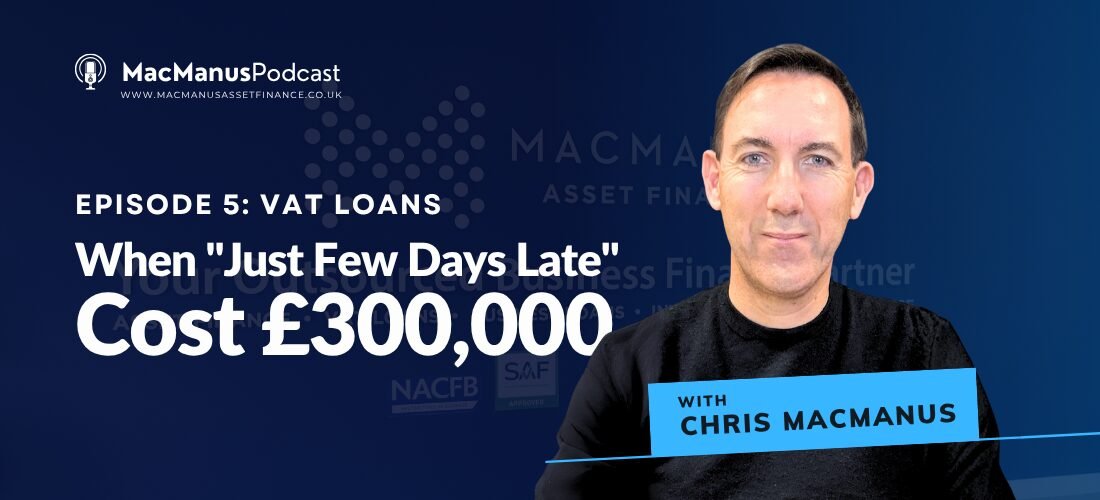
For many UK SME directors, VAT is treated as a routine obligation — something to be paid every quarter and moved on from.
But what happens when payment is delayed… even by just a few days?
In this episode of Your Business Finance Partner, we uncover the hidden risks behind late VAT payments — and why what seems like a minor delay can quickly escalate into a serious financial problem.
More importantly, we explore how VAT Loans UK provide a structured solution to manage these obligations without placing unnecessary pressure on cash flow.
Because when it comes to VAT, timing matters far more than most businesses realise.
Why VAT Timing Matters More Than You Think
VAT is not optional, and it is not flexible.
Once your VAT return is submitted, the payment deadline is fixed. Unlike supplier relationships or internal expenses, HMRC operates on strict timelines — and enforcement is consistent.
For businesses managing uneven cash flow, this creates a challenge.
You may be:
- Waiting on customer payments
- Managing large upfront costs
- Experiencing seasonal fluctuations
- Investing in growth
Even profitable businesses can find themselves short at the point a VAT bill is due.
The assumption is often: “We’ll pay it a few days late — it won’t make much difference.”
In reality, that mindset can be costly.
The Hidden Cost of “Just a Few Days Late”
One of the most important insights from this episode is how HMRC assesses late payments.
It is not just about a single delay — it is about patterns.
Repeated late payments, even by a few days, can trigger escalating penalties over time.
In one real-world example, a business that consistently paid VAT slightly late faced penalties of over £300,000.
Not because of one major failure — but because of repeated small delays.
This is where many SMEs get caught out.
Cash flow gaps are common. Late payments feel manageable. But over time, those delays build a track record that HMRC actively monitors.
And once that pattern is established, the cost can escalate quickly.
The True Cost of Doing Nothing
Ignoring VAT timing issues does not make them disappear.
In fact, the longer the pattern continues, the more expensive it becomes.
The risks include:
- Financial penalties
- Interest charges
- Increased scrutiny from HMRC
- Pressure on working capital
- Disruption to financial planning
Beyond the direct cost, there is also the operational impact.
When VAT becomes a recurring stress point, it affects decision-making. Businesses may delay investment, reduce spending, or divert funds from growth just to stay compliant.
This is why VAT should not be treated as a last-minute obligation.
It should be planned and structured in advance.
What Is a VAT Loan and How Does It Work?
A VAT loan is a short-term funding solution designed specifically to help businesses pay their VAT bill on time.
Instead of using working capital to cover a large lump sum, the loan allows you to:
- Pay HMRC in full and on time
- Spread the cost over manageable monthly repayments
- Protect cash flow for operational needs
In simple terms, it converts a large, immediate liability into a structured payment plan.
This can be particularly valuable for businesses with:
- Long payment cycles
- Seasonal revenue
- Rapid growth
- High upfront costs
Understanding how VAT loans UK work is key to removing unnecessary pressure from the business.
Why VAT Loans Are a Strategic Tool — Not Just a Short-Term Fix
There is often a misconception that using funding for tax liabilities is a sign of weakness.
In reality, it is a strategic decision.
Strong businesses manage cash flow deliberately. They protect working capital and ensure obligations are met without disrupting operations.
A well-structured VAT loan can:
- Prevent penalties entirely
- Maintain liquidity
- Support ongoing investment
- Improve financial stability
It allows businesses to remain compliant while continuing to operate efficiently.
This is not about solving a problem after it happens — it is about preventing it altogether.
Planning Ahead: Funding Readiness for Tax Obligations
The most effective approach to VAT is proactive planning.
This includes:
- Forecasting upcoming VAT liabilities
- Monitoring cash flow cycles
- Setting aside reserves where possible
- Exploring funding options in advance
Having a funding solution ready — before the deadline approaches — removes pressure.
It allows decisions to be made calmly, rather than reactively.
For many SMEs, this shift from reactive to proactive financial management is where real improvements happen.
The Bottom Line
Late VAT payments are rarely caused by poor business performance.
More often, they are the result of timing — cash flow gaps between income and obligations.
However, the consequences of those delays can be severe.
HMRC does not just look at individual payments. It looks at patterns.
And repeated delays, even small ones, can lead to significant financial penalties over time.
Understanding this risk — and planning for it — is essential.
VAT Loans UK provide a simple, structured way to manage these obligations, protect cash flow, and avoid unnecessary cost.
Because in business finance, small delays can become big problems.
And the right solution, in place at the right time, can save far more than it costs.
Ready to Make Asset Finance Work for Your Business?
Partner with MacManus Asset Finance Ltd, an independent broker established in 2005, helping UK SMEs access tailored finance solutions.
Our friendly, professional, and consultative team works across all industries and can guide you through hire purchase, leasing, and finance lease options. With access to over 60 finance companies and full FCA authorisation, we ensure your business finds the right solution for growth.
Send us a message or Book a meeting today.